Friday, June 03, 2011

Crab Quiche with Hollandaise

(Photo from Taste of Home)
Last night I tried a new recipe for supper: Crab Quiche with Hollandaise. I have made crabmeat quiches before and we always enjoy the flavors. But this is probably the most flavorful crab quiche recipe I have ever tried and will probably be the one I use from now on. It contains frozen asparagus stir-fry blend, one of our favorite frozen vegetable mixtures. (I usually buy the Great Value brand.)

I did make a couple of changes. I used about half the amount of cheese and I used imitation crab, about 4 ounces, instead of canned crab. Also, I used a packet of hollandaise sauce mix rather than making homemade hollandaise sauce as specified in the recipe.

If you're looking for a good quiche recipe, give this a try. If your family enjoys seafood quiches, I predict you will enjoy this as much as we did!

Thursday, June 02, 2011

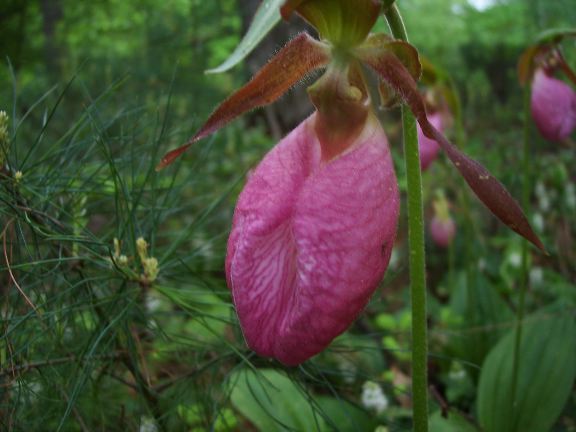
Lovely lady's slipper flowers


Last weekend Mr. T got some wonderful photos of our pink lady's slipper flowers. I thought it would be of interest to share not only the pictures, but also what my Wildflowers of North America book (by Robert Lemmon and Charles Johnson) has to say about them:

"Pink Lady's Slipper, Pink Moccasin, Stemless Lady's Slipper, Two-Leaved Lady's Slipper, Squirrel Shoes, Noah's Ark, Whip-poor-will shoe -- all these common names and probably more are applied to this woodland plant. It is perhaps the most common, widespread and at the same time the crankiest member of its genus. To illustrate:

"You may find it flowering in May and June from Newfoundland through New England and on to North Carolina. From this general line it extends west to Tennessee, into the Mississippi River region and Manitoba. Bogland, damp woods and dry rocky ones -- all are acceptable homes for it. And yet it is notoriously difficult to transplant successfully into some new spot which seems to be perfectly suited to its needs. It may appear there by itself, probably by means of stray seeds, and become well established. But that is another mystifying story.

"This baffling, unpredictable Orchid rarely grows in close colonies. You may find several plants within a square yard, but as a rule they are more widely scattered. It is almost as though they resented crowding."

Who knew they had so many common names? I was only familiar with the first two. Some of the names surely are whimsical.

I can also vouch for the fact that these plants are unpredictable. When we moved here, we had large groups of lady's slippers in our woods. Over time, the groups seemed to get smaller and move around from place to place in the woods. We tried transplanting a couple of them to the wildflower garden, where they thrived for a few years and then disappeared.

This year, they are in a slightly different place still -- in fact, at the edge of the woods quite close to the road. Some are light pink, some are dark pink.

Some are solitary, some are in small groups, like this one of four.

Mr. T counted some 40 lady's slippers just in this area alone!

Do pink lady's slippers grow in your area?

Wednesday, June 01, 2011

Lilacs


When I was growing up, my parents had some pretty lilac bushes and so when we established our own home, Mr. T and I wanted to plant some, too. We ended up transplanting some from my parents' summer place, where there was a huge hedge of lilacs near an old stone foundation. For years, our lilacs did not bloom; then, a few years ago, one or two blossoms appeared. Each year we see more and more flowers, and the bushes themselves are spreading, too.

I think it is so fascinating how lilacs are so often found beside old cellar holes and crumbling foundations. Even out in the woods, lilac bushes can be found blooming in such surroundings. People planted them by their houses and now, even though the houses and outbuildings have long since disappeared, the lilacs continue to bloom. Writers have written eloquently about this:

"Lilacs are in bloom now ... They bloom in almost every dooryard. In fact they bloom where there is no longer a dooryard. Often only a stone chimney may be left where a house once stood.

"Who lived here? ... Did they build the vanished house for future generations? If so, why was the place abandoned? Lovingly it could have been rebuilt on the same site, for the ancient stone foundation is here. Never mind, the secret belongs to the long ago, and we must not disturb it. It is permissible to gather a few lilacs in memory of those who planted them."
~ Gladys Taber, The Stillmeadow Road


And Still the Lilacs Bloom


'Twas not by chance the lilac fair
Became New Hampshire's flower,
For it was hardy like the folks
Who grew it by their bower.

The farms were passed from sire to son
Who loved this land and nation;
And lilacs were a part of home
To every generation.

Years passed, until the farmhouse old
Fell slowly in decay,
Yet lilacs by the rotting walls
Still bloomed along the way.

The ones who planted yonder bush
Are now within their tombs,
But still beside the cellar hole
The purple lilac blooms.

As though in tender memory
Of those they would recall
Each year the fragrant lilacs bloom
Beside the garden wall.

No fairer tribute to the dead
Can we in love display
In cemeteries through the land
Upon Memorial Day.

Though gnarled and twisted by the storm
As generations toil;
Forever may the lilacs bloom
O'er dear New Hampshire soil.
~ Wilfred Tatham, Musings by a Mountain Trail


I love our lilacs and hope they will continue blooming and thriving for many years to come. They are such sweet old-fashioned flowers!

A few more wildflowers

Here are just a few more wildflowers.

Bunchberry -- these flowers will soon disappear and a cluster of berries will take their place.

Lily of the valley -- I love these for their scriptural significance. These are not technically a wildflower, as they were transplanted by Carrie from one of my mother's flower gardens many years ago. But they have spread, over the years, to all corners of the wildflower garden. Their scent is simply delicious.

Bugle weed -- also called simply bugle. These plants were given to Carrie by a friend, Mrs. C, many years ago. To my knowledge they have only started blooming in the past year or so.

A closer look at the bugle weed. Isn't it pretty?

Monday, May 30, 2011

The bird-on-the-wing is back!


I know that last year I shared about this, but it's exciting enough to mention again -- the bird-on-the-wing is blooming again in the wildflower garden!

Last year I mentioned how that, many years ago, my daughter Carrie (a young teen at the time) planted a wildflower garden. She did so much work, clearing a spot at the edge of the woods, making brick paths, and transplanting wildflowers from our woods. Other people kept her in mind and brought her plants from their own wildflower gardens, or even from their regular flower gardens.

Her Grandpa T. was a true wildflower enthusiast who taught her much and brought her many plants. (He faithfully kept a list of the wildflowers he encountered each spring!) One such plant was the fringed polygala, otherwise known as bird-on-the-wing or gay wings. It is a beautiful fuchsia wildflower that to me looks exactly like a tiny fuchsia airplane, propeller and all!

To my knowledge the bird-on-the-wing he brought never bloomed again -- until 2010. I was so thrilled and surprised to find it blooming!

Last week I thought about it again and decided to check the garden. Sure enough -- it is not only there, but has spread.

I hope that soon, Carrie will be able to take a few plants to her own home for one of her gardens there.

Here's what my wildflower book says about the fringed polygala:

"Fringed Polygala is one of those reticent little woodlanders whose small size causes them to be missed by many people unaccustomed to looking for small plants. This is especially true in the subdued light which prevails in its accustomed haunts. A large part of this peculiar plant is hidden underground in ithe form of slender, rootlike stems which branch freely and slowly spread farther and farther. These often bear a few closed, subterranean flowers which never open yet are self-fertile and produce seeds. Thus the plant has two seed sources on which it can depend for starting new generations. Its range extends from Quebec to Georgia, especially in the Appalachian system, and out into Wisconsin."
~ Wildflowers of North America, by Robert S. Lemmon and Charles C. Johnson

Maybe you have this wildflower blooming in your area! Have you seen it?

Saturday, May 28, 2011

Sausage Asparagus Skillet

 (Photo from Home Joys)
We tried a wonderful main dish last night... absolutely delicious.  It came from Gina at Home Joys.  Here is the link to her recipe:  Sausage Asparagus Skillet.  This dish has marvelous flavor.


One-dish meals like this are so good.  We just served some of Gina's  Miracle Bread on the side,
 
 (Photo by Home Joys)
and what a yummy supper!  We love asparagus, and this is one more wonderful way to use it.  I would have never thought to combine asparagus with potatoes or sausage, but it is so good.

Friday, May 27, 2011

Finally!

Oh, the issues with Blogger these days!  I have been trying and trying to sign into my own blog.  When I do, it just takes me back to the same login page. It all means I can't post in my own blog or even comment on other people's. Very, very frustrating!

It has been happening to tons of other people too. I subscribed to the topic in Blogger help via email, and have tried most of the other suggestions to no avail.

Finally I got a link to Blogger in draft (draft.blogger.com) and that worked.  Now we'll see if it will let me post.